Head to Head
Murad Rapid Dark Spot Correcting Serum vs La Roche-Posay Mela B3 Serum
The clinical American system against the French pharmacy system: resorcinol, tranexamic acid and glycolic acid compared with Melasyl, printed niacinamide and gentle LHA, on chemistry, transparency and routine fit.
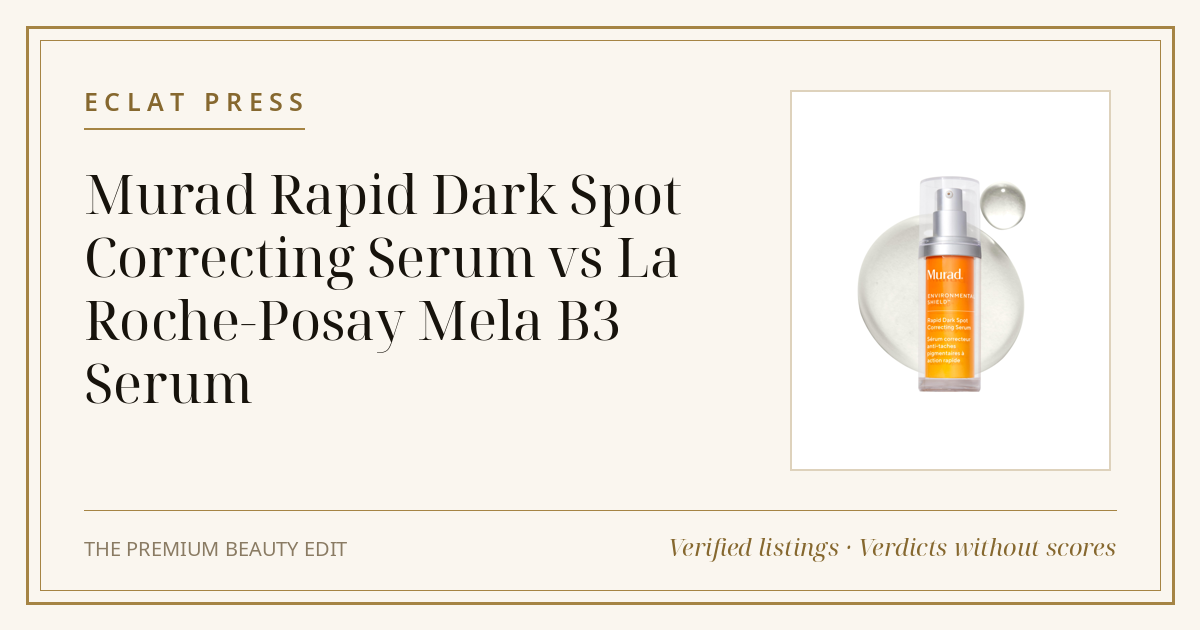

Murad Rapid Dark Spot Correcting Serum
The category's reference formula: patented resorcinol, tranexamic acid and glycolic acid working three routes in one pump.

La Roche-Posay Mela B3 Serum
A patented active with a printed percentage beside it: Melasyl and 10 percent niacinamide in a pharmacy dark spot system.
Where They Differ
Different chemistry at the core
Murad's published formula leads with patented resorcinol technology and tranexamic acid, two pigment pathway ingredients, and adds glycolic acid as a true resurfacing acid. Mela B3 leads with Melasyl, a single purpose patented molecule, beside 10 percent niacinamide, and its surface work is done by capryloyl salicylic acid, the gentle LHA that pharmacy brands use where glycolic would be too much. In practical terms: Murad changes how the surface feels as well as how spots look; Mela B3 stays quieter on texture and concentrates on tone.
Transparency runs in opposite directions
Mela B3 prints its niacinamide level on the bottle in large type and publishes its study horizon of eight weeks. Murad prints neither percentages nor a timeline, and argues from architecture instead: three named routes, unpublished strengths. A reader who buys by the label will feel more at home with the purple bottle. A reader who buys by formula design will find Murad's three route case persuasive despite the silence. Neither bottle prints everything; they simply choose different things to be silent about, since Melasyl's own level is also unpublished.
Format and daily rhythm
Murad is an airless pump in a once or twice daily slot that must be negotiated with the rest of an acid carrying routine. Mela B3 is a dropper dosed at 3 to 4 drops, directed morning and evening, with a companion sunscreen in its own line. The scent ledger also differs in kind: Murad's listing emphasises what the formula leaves out, parabens, sulfates and phthalates, while Mela B3's specifications state plainly that the serum is scented, the fact most likely to decide the purchase for fragrance sensitive readers.
The Specification, Side by Side
| Measure | Murad Rapid Dark Spot Correcting Serum | La Roche-Posay Mela B3 Serum |
|---|---|---|
| Lead Brightening Actives | Patented Resorcinol Technology, Tranexamic Acid | Melasyl, Niacinamide 10 percent printed on the bottle |
| Key Supporting Actives | Glycolic Acid for surface resurfacing | Capryloyl Salicylic Acid (LHA), Carnosine, Sodium Hyaluronate |
| Size | 1 fl oz | 30 ml / 1 fl oz |
| Format | Airless pump serum, Environmental Shield line | Dropper serum, scented as printed on the listing |
| Model | 15348, as printed on the listing | LRMBSR30, as printed on the listing |
Choose Murad Rapid Dark Spot Correcting Serum if
- Your dark spots come with dullness and rough texture, and you want the surface addressed in the same step
- Your skin is experienced with glycolic acid and tolerates a daily acid load
- You prefer a measured pump and a fragrance conscious, clinical formula character
Choose La Roche-Posay Mela B3 Serum if
- Spots and post-blemish marks are the whole brief, and texture is not the complaint
- Printed percentages matter to you: the 10 percent niacinamide is on the bottle
- You want a twice daily corrector gentle enough to sit at the centre of a pharmacy routine
Questions, Answered
Can I use Murad in the evening and Mela B3 in the morning?
You can, and readers with large routines do, but it is rarely necessary. Both are complete systems aimed at the same cosmetic goal, and running both doubles cost and complicates attribution: if your skin objects, or improves, you will not know which bottle earned it. The cleaner experiment is one full bottle of one system, judged at its published horizon, then a switch if the route itself disappoints.
Which is better for post-blemish marks specifically?
Both are positioned for post-blemish marks in appearance terms. Mela B3 is the more single minded instrument, since its whole formula, Melasyl included, was assembled for discoloration, and its gentle LHA suits skin that is still settling after blemishes. Murad answers when the marks arrive with texture and congestion that its glycolic acid can usefully address at the same time.
Keep Researching
Every page in the Dark Spot Correctors edit.
- 01Dark Spot Correctors: the hubHub
- 02Best Dark Spot Correctors 2027Best of
- 03Dark Spot Correctors for Sensitive SkinGuide
- 04Dark Spot Correctors vs Vitamin C SerumsGuide
- 05How to Use Dark Spot CorrectorsGuide
- 06Murad Rapid Dark Spot Correcting Serum ReviewReview
- 07La Roche-Posay Mela B3 Serum ReviewReview
- 08Caudalie Vinoperfect Brightening Dark Spot Serum ReviewReview
- 09Caudalie Vinoperfect Brightening Dark Spot Serum vs Clinique Even Better Clinical Dark Spot Clearing SerumComparison
- 10Dark Spot Correctors Buying GuideBuying guide
- 11Dark Spot Corrector Care and KeepingCare
More from the Serums and Treatments Desk
Serums and Treatments
Anti-Aging Creams
Eleven premium creams for the look of lines, read by active system rather than by promise
Read the edit
Serums and Treatments
Face Serums
The premium serums a reader meets first, sorted by the job each one actually does
Read the edit
Serums and Treatments
Hyaluronic Acid Serums
Premium hyaluronic acid serums sorted by formula weight, partner hydrators and skin fit
Read the edit
Disclosure: links on this page are affiliate links. As an Amazon Associate, Eclat Press earns from qualifying purchases, at no added cost to you. Rankings are never sold. See our affiliate disclosure and methodology.